
The Daughter of Kumari: Translator’s Afterword
It is not often that one gets the chance to work on a book that’s creative literature, performance, ritual and a play with the gods, all at once.
Translating this book gave me a certain intuition about translation and creativity: that translation, too, is literary performance, ritual and play, that it is as constrained and as free as any creative art.
This led me to a second intuition, a startling inversion of the first: that all creation is, in a sense, translation.
In this frame of thought, creative art, too, can be considered a translation — a translation of nature and the world, as perceived through the range and limits of the senses.
But if we accept that, then a second question arises: what, then, is nature and the world the translation of?
There are further questions if we decide to pursue this line of thought — How is such a translation achieved? What are the constraints of such a translation, and where is it free? How do we “read” this translation? Then the question that is asked of all translations – can the “translation” give us access to the “original” behind it? How “faithful” is this translation to its unseen original?
These questions lead us into metaphysics, and perhaps, if we are so inclined, into religion. The literary artist, however, has use for only one portion of religion, the portion that intersects with metaphysics and poetry.
Robert Frost’s perceptive line, Nature’s first green is gold, is religious in its certitude, its benevolence, its vivid colour and celebration, its sublime loftiness. But it is also metaphysical. How does gold become green? Or if you are a translator: how is gold translated into green? It is creative, it is mystical, and the way this particular creative mysticism is pronounced by Frost (perceptively, sensually, prophetically, minimally) makes it poetic.
The Daughter of Kumari is a novel endowed with all the creative mysticism and formal economy of Robert Frost’s line. The novel’s subject is ostensibly historical realism. It is the fourteenth century in south India; the icon of goddess Meenakshi that has been sheltered in the kingdom of Venad near Kanyakumari to protect it from invaders has to be returned back to Madurai, her home-country.
However, sending a goddess away from one’s lands, even if it is but a metal idol barely a cubit tall, is considered inauspicious, a feeling that is as much about embodiment and ritual as it is about faith and devotion. The king of Venad solves this quandary by adopting the goddess Meenakshi as his own daughter, and giving her away in marriage — an auspicious proposition by all means — to Sundaresan Siva, the lord of Madurai.
The rest of the novel is the story of a wedding — the cosmic, celestial wedding of Meenakshi and Sundaresa that is the stuff of myth, purana and classical literature — as it is of a wedding-play — performative, ritualised, translated-into-the-world — enacted to solve a historical conundrum and to ensure benevolence, auspiciousness and well-being for all the world. A mangala-kavya of old translated into the idiom of the modern literary novel.
If the wedding in the novel, as performance, as ritual, as play, is the green of Meenakshi, the matrix of feelings evoked by the novel keeps cuing us to the gold behind it, the gold that the performance is a worldly translation of. Unlike in Frost’s poem, this is a gold that stays. Humans play with gods, and the gods, too, seemingly play with humans. There are moments in the novel when the two brush hands, when a green finger is touched by a golden tip.
It is a touch that is very intuitive to any practitioner of the creative arts. It was in translating this novel that I came to realise that my trade isn’t too different after all, that it is this little art that the gods, too, are playing at all the time. For my still-very-green heart, this understanding was possibly the first touch of ripening.
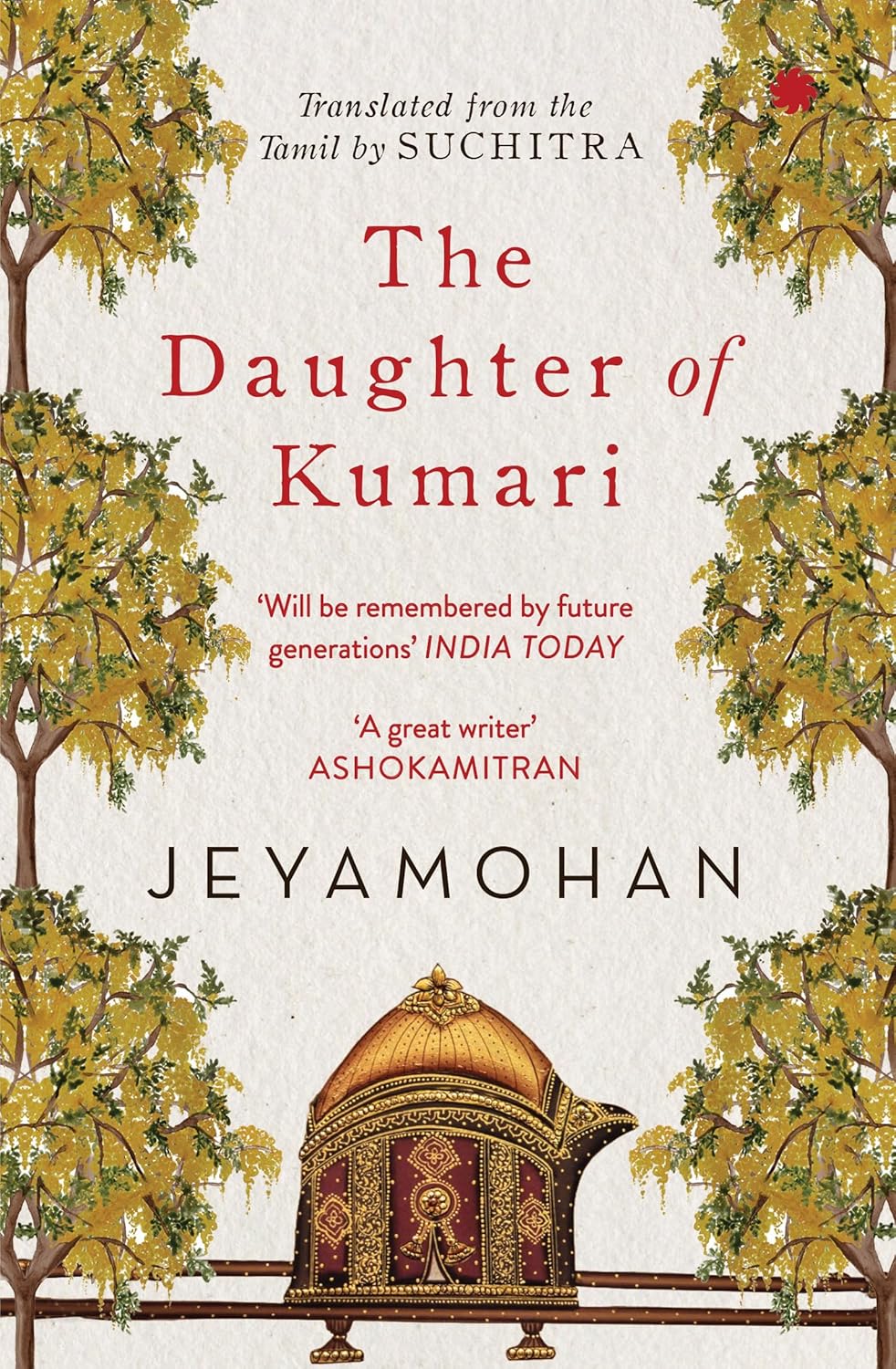
The Daughter of Kumari
Jeyamohan
Translated from the Tamil by Suchitra
Purchase link: Amazon
 Suchitra
You must be logged in to post a comment.